
Coca-Cola in France
1919 - A Humble Beginning
1919: World War I has ended. American soldiers are still present but are gradually leaving the country. During the war, the Americans built a modern port near Bordeaux, which was used by ships to transport troops back to America. An American, Raymond Aaron Linton, had the idea of importing Coca-Cola there and selling it to the soldiers. He partnered with Georges Delcroix, a former French officer from a family of wine merchants. The two partners, with a major advertising campaign, began distributing bottles in Paris.
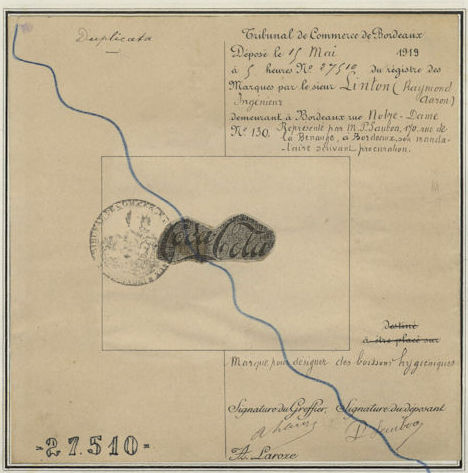
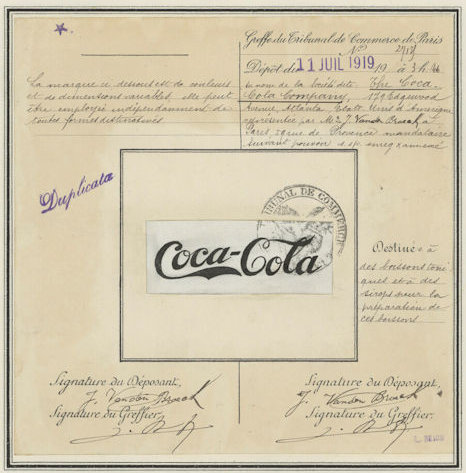
There is some uncertainty regarding this period. According to the National Institute of Industrial Property (INPI in french), which has archives available online, the Coca-Cola trademark was registered twice. The first time by Raymond Aaron Lindon and the second on July 11, 2019, by J. Vanden Broek. It appears that only the latter was authorized by The Coca-Cola Company to do so. The logo used by the earlier registrant, as well as the product description labeling it a “hygienic beverage,” do not appear to be compliant.
In the years that followed, Coca-Cola bottles were sold in France—there’s no doubt about that. Were they imported or bottled in France? Here again, opinions differ. In any case, the Société Française des Breuvages Naturels (SFBN) opened a factory in Paris at 13 Rue Félix Faure. While the production equipment was being set up, the SFBN started out using bottles imported from the United States before switching to bottles manufactured in France. This marked the beginning of Coca-Cola’s success, as it became available in most French bars. But with war fast approaching, raw materials became scarce, and the SFBN went bankrupt.
After World War II - Industrialization

After the D-Day landings, the American soldiers began sharing their bottles of Coca-Cola (along with chewing gum, chocolate, and silk stockings) with the French population.
After the war, the Société Parisienne de Boissons Gazeuses (SPBG) began producing and distributing Coca-Cola in Paris, before the network of bottlers expanded to the provinces. Alcoholic beverage manufacturers and the newspaper L’Humanité called for a boycott of this American drink during a period when the Marshall Plan (1947) was providing economic aid to Europe but required the importation of American products in return. But ultimately, thanks to French factories, effective advertising campaigns, and the installation of beverage dispensers in department stores and offices, Coca-Cola succeeded in establishing itself as the leader in non-alcoholic beverages that we know today.
For more information, I invite you to consult:
- Coca-Cola en France: une aventure industrielle, published by Éditions de la Martinière (2015)
- Coca-Cola – France 1919 by René Demol. Edited by Chantal Demol Bodengien and René Demol (2019)
- https://www.cocacolaep.com/fr/qui-sommes-nous/notre-histoire/